IoT term is past the point of no return and is now officially one of those buzzword that “serious” business need to brand themselves with in order to keep up with the time.
Lets have a look at the domain and do a quick mapping of the IoT value chain. What we discover is that a good portion of the value chain is already heavily commoditised but surprisingly some key aspects are not.
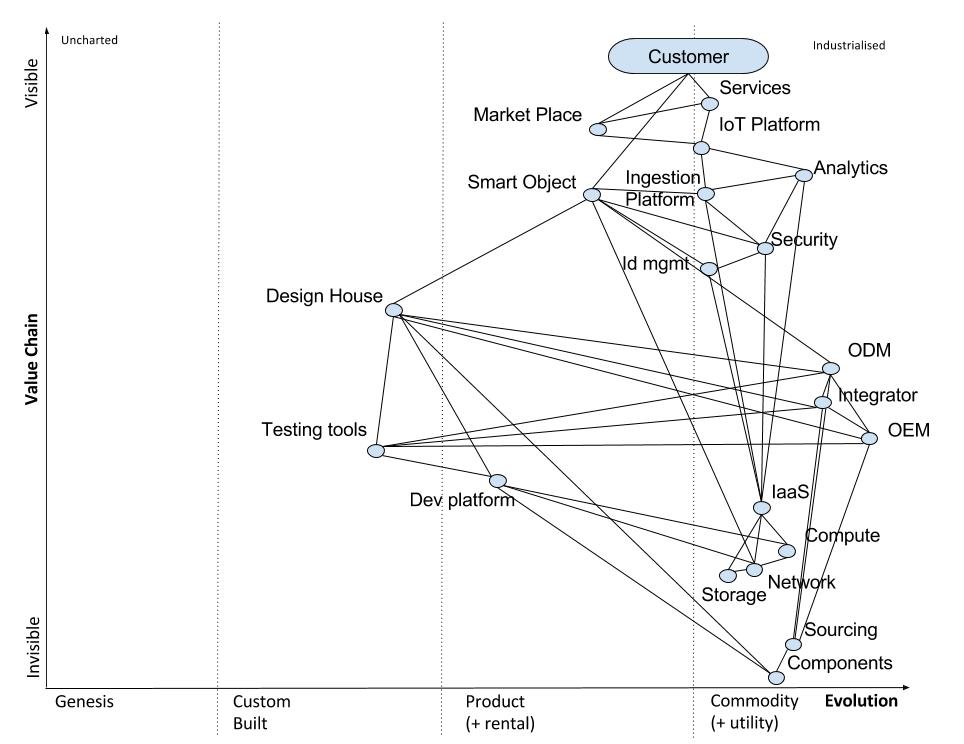 |
| Current IoT Value Chain |
First, we might ask why testing and dev platform are not as commoditized as the rest of the value chain. We have to remember that we are not developing software only. We need to validate if the a combination of hardware + software as well as its behavior within the overall IoT ecosystem.
The dev/test requirement for Internet of Things is a significant challenge. The scale of the systems is big because they contains large number of units spatially distributed. And the larger the scale, the harder it is to test within the software development lab for testing. Corporation do not have the financial capabilities to deploy
large scale IoT testing like google does.
Moreover, as
Nest CEO,Tony Fadell, explain in Stanford’s industrialist dilemma session : Testing software, testing procedures, test fixtures, (everything test) are critical IP that need to be protected in order to retain competitive advantage. As a result, the overall testing and, to a certain extend, dev remained closely guarded aspect of the value chain. Company kept these two at lower end of the shift toward commoditization in order to increase the barrier to entry.
 |
| IoT Value Chain Transition |
However, with the increased demand, the ineluctable commoditization process will accelerate. And simulation will be at the heart of it by enabling companies to virtually deploy IoT devices over a virtual space and test their behavior. Using such environment, they will can model and test cheaply every aspect of the system, such as connectivity , disruptions, etc.. Instead of manually handling and maintaining hundreds of devices we will be able to do it via an API. While, we still need to do hardware testing we probably reduced the overall cycle by an order of magnitude and allow faster release of new product.
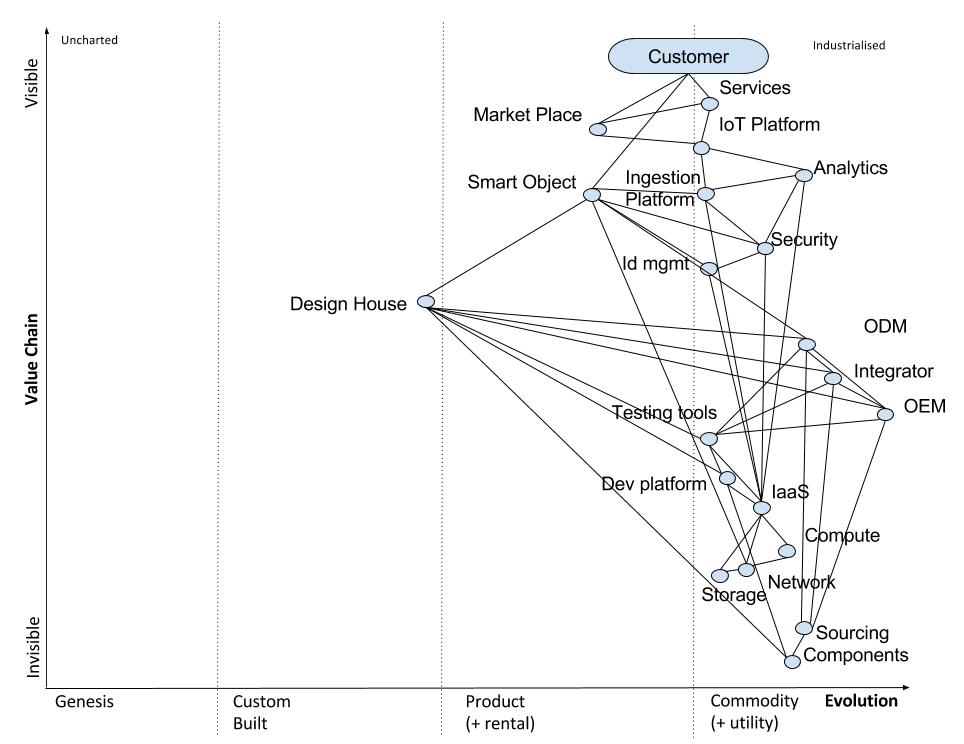 |
| Future IoT Value Chain |
Currently, most cloud player have offered IoT solution that revolve around analytic and have made almost no foray in the testing and dev platforms. However, they are poised to offer cloud IoT testing platform which will generate a shift in power within this field (as shown above). It is going to be great for smart object designer houses as it will steal away the leverage from bigger player ( Honeywell , GE, etc..) by breaking the barrier to competition while enabling an explosion of the IoT ecosystem.
To be honest, I wouldn’t be surprised if Amazon did a play in that field. They have already an significant interest in IoT and 3d printer. It would be a natural step for Amazon, enabling the company to lock down yet another market.


