- Comixify: Transform video into a comics with the power of machine learning. This is a really cool concept and the results are surprisingly good.
- A Storm in an IoT Cup : the authors look at the emergence of social machines where human interactions and relationship is made increasingly more complex with the rapid adoption of the Internet of Things.
- Baker : a library by ING bank that aims at reducing the efforts to orchestrate (micro)services process flows. The objective is to bring everybody from the product owners, architects and developers to talk the same language by relying on a unique service based processed workflow. While in itself it is not revolutionary. The DSL principle allows greater reusability of microservices as well as facilitating the comprehension and review of complex workflows.
A blog about life, Engineering, Business, Research, and everything else (especially everything else)
Showing posts with label iot. Show all posts
Tuesday, January 08, 2019
[ Links of the Day] 08/01/2019: Turn video into comics, Social impact of IoT, and Microservices orchestration DSL
Labels:
iot
,
links of the day
,
machine learning
,
microservices
,
social
,
workflow
Thursday, February 25, 2016
IoT next battlefield: test/dev platform commoditization
IoT term is past the point of no return and is now officially one of those buzzword that “serious” business need to brand themselves with in order to keep up with the time.
Lets have a look at the domain and do a quick mapping of the IoT value chain. What we discover is that a good portion of the value chain is already heavily commoditised but surprisingly some key aspects are not.
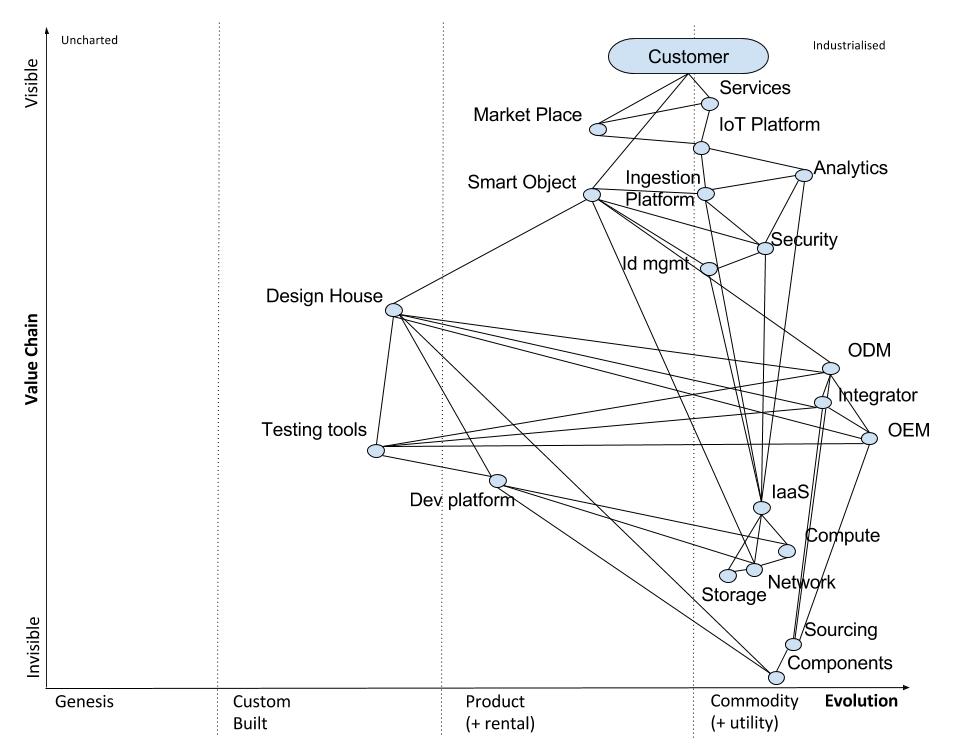
First, we might ask why testing and dev platform are not as commoditized as the rest of the value chain. We have to remember that we are not developing software only. We need to validate if the a combination of hardware + software as well as its behavior within the overall IoT ecosystem.
Lets have a look at the domain and do a quick mapping of the IoT value chain. What we discover is that a good portion of the value chain is already heavily commoditised but surprisingly some key aspects are not.
| Current IoT Value Chain |
First, we might ask why testing and dev platform are not as commoditized as the rest of the value chain. We have to remember that we are not developing software only. We need to validate if the a combination of hardware + software as well as its behavior within the overall IoT ecosystem.
The dev/test requirement for Internet of Things is a significant challenge. The scale of the systems is big because they contains large number of units spatially distributed. And the larger the scale, the harder it is to test within the software development lab for testing. Corporation do not have the financial capabilities to deploy large scale IoT testing like google does.
Moreover, as Nest CEO,Tony Fadell, explain in Stanford’s industrialist dilemma session : Testing software, testing procedures, test fixtures, (everything test) are critical IP that need to be protected in order to retain competitive advantage. As a result, the overall testing and, to a certain extend, dev remained closely guarded aspect of the value chain. Company kept these two at lower end of the shift toward commoditization in order to increase the barrier to entry.
However, with the increased demand, the ineluctable commoditization process will accelerate. And simulation will be at the heart of it by enabling companies to virtually deploy IoT devices over a virtual space and test their behavior. Using such environment, they will can model and test cheaply every aspect of the system, such as connectivity , disruptions, etc.. Instead of manually handling and maintaining hundreds of devices we will be able to do it via an API. While, we still need to do hardware testing we probably reduced the overall cycle by an order of magnitude and allow faster release of new product.
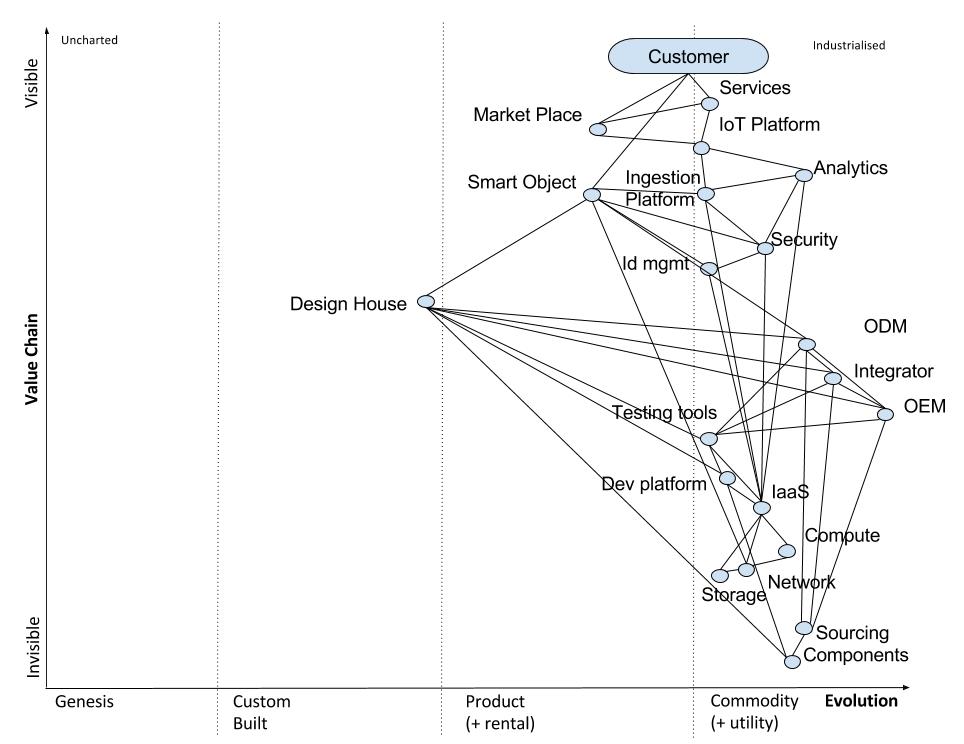
Currently, most cloud player have offered IoT solution that revolve around analytic and have made almost no foray in the testing and dev platforms. However, they are poised to offer cloud IoT testing platform which will generate a shift in power within this field (as shown above). It is going to be great for smart object designer houses as it will steal away the leverage from bigger player ( Honeywell , GE, etc..) by breaking the barrier to competition while enabling an explosion of the IoT ecosystem.
To be honest, I wouldn’t be surprised if Amazon did a play in that field. They have already an significant interest in IoT and 3d printer. It would be a natural step for Amazon, enabling the company to lock down yet another market.
Moreover, as Nest CEO,Tony Fadell, explain in Stanford’s industrialist dilemma session : Testing software, testing procedures, test fixtures, (everything test) are critical IP that need to be protected in order to retain competitive advantage. As a result, the overall testing and, to a certain extend, dev remained closely guarded aspect of the value chain. Company kept these two at lower end of the shift toward commoditization in order to increase the barrier to entry.
![]() |
| IoT Value Chain Transition |
However, with the increased demand, the ineluctable commoditization process will accelerate. And simulation will be at the heart of it by enabling companies to virtually deploy IoT devices over a virtual space and test their behavior. Using such environment, they will can model and test cheaply every aspect of the system, such as connectivity , disruptions, etc.. Instead of manually handling and maintaining hundreds of devices we will be able to do it via an API. While, we still need to do hardware testing we probably reduced the overall cycle by an order of magnitude and allow faster release of new product.
| Future IoT Value Chain |
Currently, most cloud player have offered IoT solution that revolve around analytic and have made almost no foray in the testing and dev platforms. However, they are poised to offer cloud IoT testing platform which will generate a shift in power within this field (as shown above). It is going to be great for smart object designer houses as it will steal away the leverage from bigger player ( Honeywell , GE, etc..) by breaking the barrier to competition while enabling an explosion of the IoT ecosystem.
To be honest, I wouldn’t be surprised if Amazon did a play in that field. They have already an significant interest in IoT and 3d printer. It would be a natural step for Amazon, enabling the company to lock down yet another market.
Monday, February 22, 2016
[Links of the day] 22/02/2016: Quantum computing as a Service, Alexa - Amazon IoT platform, SNIA nvm videos
- Quantum Computing as a Service : Stanford seminar on "Quantum Computing as a Service" by Matt Johnson & Randall Correll of QCWare. What is stand out from most of the talk is that quantum computing is really a solution looking for a problem. You can speed up certain problem solving by an order of magnitude but paying customers with this type of problems seems scares. It can just be an educational problem and it seems they are trying to tackle this aspect well. However, they didn't talk about the elephant in the room : breaking cryptography for fun and profit. Maybe to sensitive of a topic?
- Alexa : Amazon tech talk on its IoT platform
- SNIA nvm summit : all video are uploaded , checkout the linux NVM talks and nvm over fabric one.
Wednesday, February 17, 2016
[Links of the day] 17/02/2016: IoT + Sensor day at Berkeley, Financial of Hybrid cloud, bigdata lib
- Sensor Net Day : One day workshop on IoT / Sensor at Berkeley Citris lab. All the slide decks are available. Little gem by joe hellerstein on sensornet tasking in the large that remind me a lot of my PhD work and the work on amorphous computing from MIT.
- Sframe : column based data frame that is compressed and disk-backed. It’s optimized for data science and machine learning. [github]
- Financial Challenges of Hybrid Cloud vs. Public Cloud Migration : Wikibon analysis has an interesting claim : it seems that adopting an hybrid cloud strategy can generate three times more value with a 6 month break-even horizon while all-public cloud strategy has break-even horizon of 25 months.
Labels:
berkeley
,
bigdata
,
cloud
,
financial analysis
,
hybrid
,
iot
,
library
,
links of the day
,
sensor
Friday, January 22, 2016
On Docker absorbing Unikernel
Docker just bought Unikernel. This is an interesting move from this company. It allows Docker to make a counter move to its usual strategy which revolved around expanding its deployment practice, management tools and platform management offer.
The main attraction of unikernels, for Docker and its users, are performance and security. While some may argue that performance might be a red herring. You have to remember that, with unikernel, Docker is able to make a significant foray in the world of :
In order to make unikernels attractive to the current its current developer base. Docker will have to put tremendous efforts in creating user friendly DevOps mechanism that made Docker popular. This is a significant challenge as unikernels often requires specific tools and application build to run. Making this offer transparent and easy to use will make or break this acquisition. Capstan from OsV is a step is a right direction to achieve that by example.
However, Docker might have a darker motivation :
- networking where real time performance in NVF is crucial (Rump is really nice for that). Storage might also be another use case.
- IoT where speed and minimalist footprint provide a significant advantages
In order to make unikernels attractive to the current its current developer base. Docker will have to put tremendous efforts in creating user friendly DevOps mechanism that made Docker popular. This is a significant challenge as unikernels often requires specific tools and application build to run. Making this offer transparent and easy to use will make or break this acquisition. Capstan from OsV is a step is a right direction to achieve that by example.
However, Docker might have a darker motivation :
- if docker successfully embrace the unikernel tech, will accelerate the vendor lock in due to its inherent nature.
- if docker fails it would have simply extinguish a competitor and part of a competing tech with it.
Thursday, January 15, 2015
Links of the day 15 - 01 - 2015
Today's links 15/01/2015: #kafka, #IoT , #IBM z13
- Exactly-once Messaging Patterns in Kafka : send something exactly once is harder than making sure it has been sent at all.
- Internet of things - Blackett review : review by the UK Government Chief Scientific Adviser on on the internet of things.
- IBM Z13 :
Wednesday, January 07, 2015
Links of the day 07 - 01 - 2015
Today's links 07/01/2015: #google #cloud #benchmark , #IoT , #CI tales
- The Challenge of Fairly Comparing Cloud Providers and What We're Doing About It : how Google is looking into benchmark solution for cloud and make them relevant within the cloud context by Anthony Voellm, Google
- Exploring the Protocols of IoT : a look into MQTT and CoAP IoT communication protocols
- Continuous Delivery Stories : share stories from leading practitioners who’ve been there and report from the trenches.
Labels:
benchmark
,
cloud
,
continuous delivery
,
iot
,
links of the day
Subscribe to:
Posts
(
Atom
)


