Showing posts with label oracle. Show all posts

Tuesday, December 06, 2016

Another tale of Execs bottom-up Blindness : SAP, Oracle, [Insert Software Giant here] vs AWS


After watching this year's AWS re:Invent show, I can help but have this strange feeling of “déjà vu”. AWS achieve to deliver exciting new product and solution that take the industry by storm. GreenGrass literally take my last year prediction and makes it reality. What’s even scarier is that, with GreenGrass, AWS achieve the feat of unifying #IoT and #DevOps under a common platform. 

But my feeling of déjà vu didn’t come from the GreenGrass announcement. It came from the Step Functions announcement. And it felt like a textbook repeat of what happened to Detroit's big three when Toyota took over the US car market: Another case of bottom up blindness.


Step is the natural next step in the evolution of AWS product portfolio. It nicely complement the serverless lambda product and allow to organise your server-less logic flow in a transparent manner. 


But what is more important is the implication of such release. Step allow you to create and coordinate complex workflow. Which is just a step off having a full blown ERP. It is actually even better than an ERP as Step allow you to coordinate any kind of distributed application. Allowing you to define business process workflows that blend seamlessly business logic and application logic. 

24 hours before the release of Step, I was mentioning on Twitter that AWS just needed a good process workflow service to open up the ERP business. 


One day later, Step Function emerged and it won’t be long before we see emergent ERP like functionality hosted on Step / Lambda. This release sound like a swan song for the like of SAP or Oracle. However they had plenty of warnings. But like many in other industry they buried their head in the sand. 

With Step, AWS has now completed offering all the building block to develop a full blown ERP without the hassle of taking care of all the nitty gritty details ( scaling, resilience, deployment etc..). To name some of the main one: 
  • Database : Redshift / Aurora / DynamoDB 
  • Data Ingestion : Firehose
  • BI : Quicksight
  • Business process : Step + lambda 
  • Mobile : AWS Mobile
SAP, especially, should have taken a hint when they announced the availability of their in memory database on AWS in 2012 and AWS announce Redshift DB a couple of day later. 
SAP , ORACLE , and many other are repeating the same error that other industry giant fell for:

Failure to master small product :
They are addicted to the revenue they extract from the fat margin of the top 20% customers ( think Nestle, CocaCola, Caterpillar, etc..). These customer deploy these massive ERP systems while smaller customer tend to be thrown upon because the margin extracted from them are not high enough. Sadly, like with the automotive industry, history repeats itself. The Detroit's big three lost to Toyota because they didn’t care to lose the small car market. Margin where small enough they deemed that Toyota could have the small car market share as long as they retained the higher end one. However by doing so Toyota gained a foothold and worked its way up the food chain while they lost market share. AWS is doing the same thing. It started with the infrastructure and is now on their doorstep looking at their crown jewel. By losing the smaller product mastery, they lose the knowledge necessary to deliver product for the companies that will become the giant of tomorrow. 


Failure to embrace cloud : 

SAP sold their hosting operation in 2009 to T-Systems. They literally sold out all their expertise that would help them transition to offer solid cloud solution. They have been left in the dust by the competition and are fooling themselves if they think they can catch up. Elisson on the other side is trying to fool its shareholder by promising to catch up AWS. However at the current rate of their infrastructure investment they will reach current AWS infrastructure size in FIVE YEAR !! 


Failure to simplify their stack :

Anybody who used an SAP or Oracle system knows how painful it is to deploy the simplest web service .. let alone an ERP system. Moreover, it is almost impossible to learn about the systems if you are not working for either a company that use them or the companies that produce them


Failure to learn : 

These software giant traditionally didn’t run their own systems. And to be honest, hardware and operational cost was often a fraction of the overall license cost. Because of that, it was easy to tell the customer to throw more hardware at the software problem. However, everything change when you start to offer your solution as a service. And SAP experienced this the hard way with their SAP Bydesign solution (discontinued in 2013 and revived a year later). Rumors was that the company was spending 7 euro to run the system for every euro it was getting from its customers.
However, they didn’t learn from their mistakes and change their approach to build, deliver, and run their systems. Look at S/4 HANA, even today you cannot run it on anything else than the humongous X1 instance. And this lack of learning seems to be widespread among the software giant industry. Surprisingly we are almost 5 year after HANA availability on AWS announcement and I have yet to see a customer running a production HANA on AWS. 


Because of these failures from bottom-up blindness, these companies easily fall prey of the Tower of Hanoï fallacy and as a result they cannot :
  • transition to a new value chain
  • acquire new technical skills/knowledge
  • expand to new market and business model
  • compete with ecosystem (cloud) natives
  • manage revenue stream self cannibalization

Traditional software giants have feet of clay and AWS already chipped its way up to the knee without them noticing.

Wednesday, February 10, 2016

The Tower of Hanoi Fallacy

The drive behind pursuing upward value chain motion is commendable in the the eyes of the shareholders. However, it often result in a costly failure or worse becoming a zombie company (Yahoo...). Most of the time, such approach fail because corporations do not understand and satisfy the core requirement driving the Innovate - Leverage - Commoditise strategy via leveraging a real ecosystem play. As a result, companies end up deploying brittle strategy with very weak underlying gameplay which under perform in a highly competitive market.
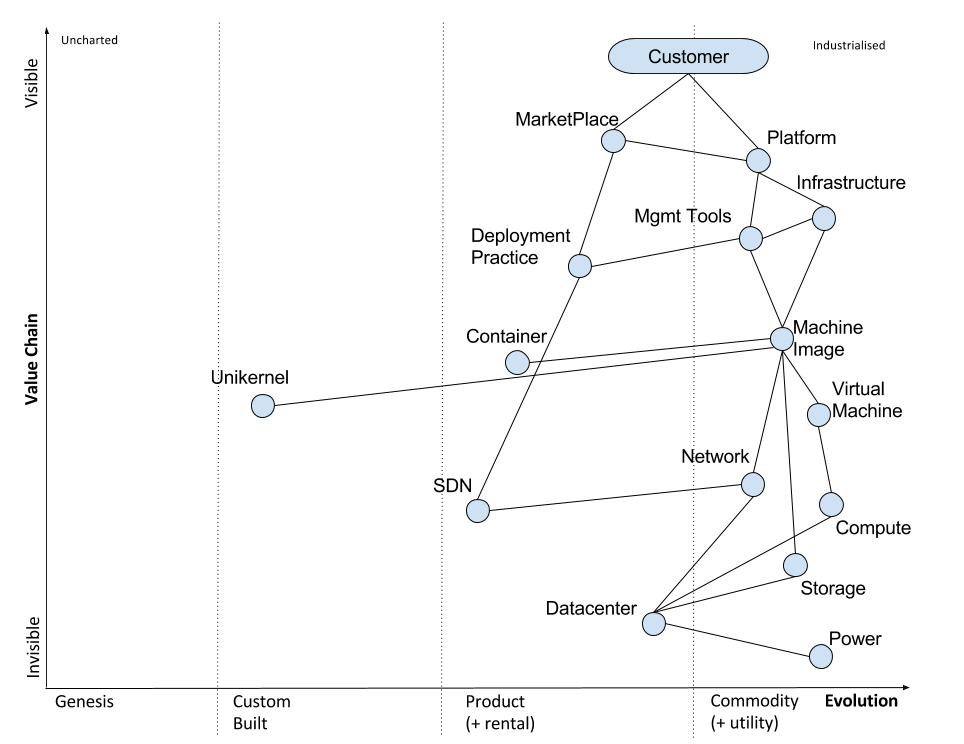
One of the main reason behind the failure of such strategy is company's lack of customer's ecosystem understanding. Software vendors, by example, have the false sense that they understand the use of their competencies (database systems or ERP) beyond the customer horizon. They regularly misunderstand the higher level of the stack valued by customers. SalesForce customers do not care if the underlying DB is from Oracle or SAP Hana. In AWS case, nobody care they run Xen, KVM or VmWare. This is perfectly illustrated in the cloud value chain mapping bellow. The only important parts is the last layer exposed to the customer itself. Anything under it is just the submerged part of the cloud iceberg.


Additionally, companies do not only fall prey to the Stack Fallacy. Sometimes, rather than (just) trying to move up the stack, corporation try to also move laterally in a bid to absorb adjacent stack. Large software vendor (ex: Oracle & SAP) are quite attracted to this tower of Hanoi play as look to force their way into a parallel stack with alternative business models. Recently these very large software corporation embrace such strategy by trying compete directly against IaaS and PaaS solution rather than co-opting them. 
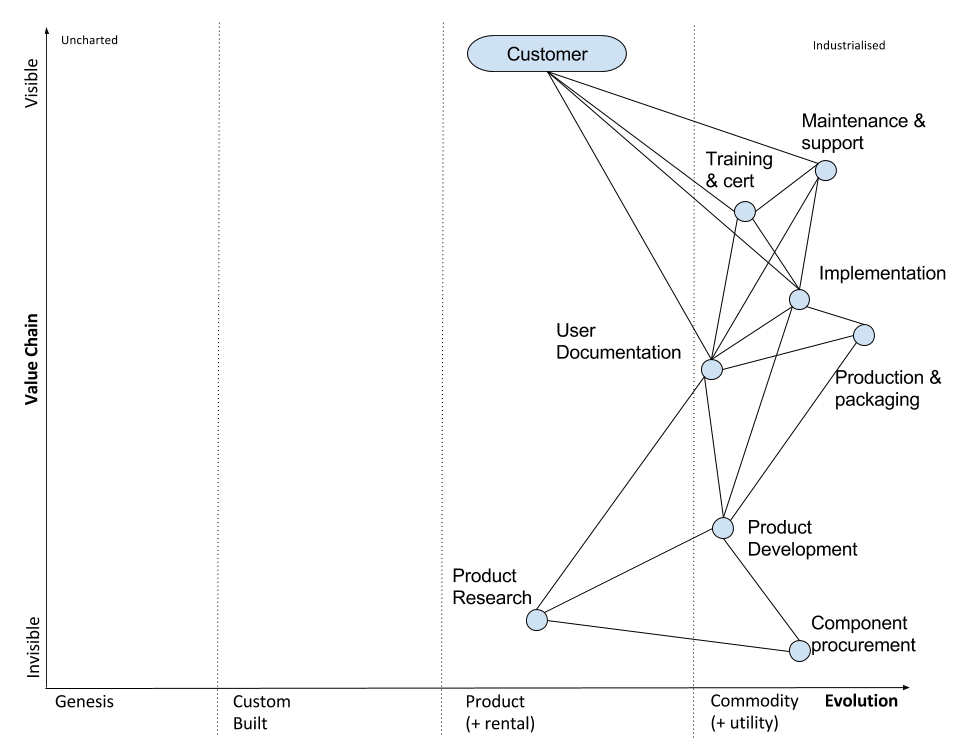
These large companies tend to have a seemingly good awareness of their competences based on the resources and knowledge that they gathered via their marketing departments, sales teams, R&D dept, etc.. This awareness allow them to maximise revenue from the software value chain (mapped below, interpretation and trimmed down version of the software value chain by Pussep and Al.) .


However, these companies have build enormous revenue base on this type of value chain. And, transitioning to a different consumption model generate a struggle originating from the financial implication of transforming from licensing to SaaS model combined with the self cannibalization of their existing revenue streams. Basically, they cannot (out)innovate competition from the market they transfer into due to internal financial tension.

Moreover, while they have a good understanding of their value chain. They often completely underestimate the new one they need to adopt. The assumption is that it is just another Tower of Hanoi play.

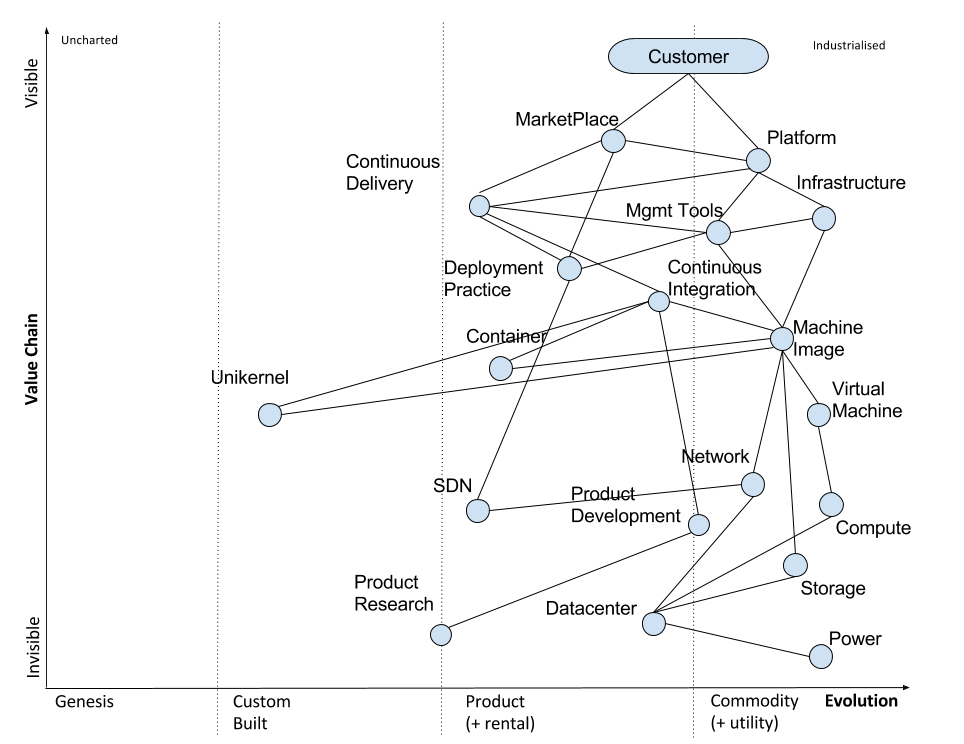
Rather than co-opting existing platform by building as a customer on top of the cloud value chain they suddenly need to expand their capabilities in order to internalize the new requirement. You can see in the diagram below the daunting challenge they are facing. Not to mention they still require to maintain their old revenue streams in order to transition. This bipolarity is not without reminding Gartner Bimodal strategy, which if often considered to be harmful.


As a result without situational awareness, it is easy to fall prey of the Tower of Hanoï fallacy as it is near impossible to achieve:
  • transition to a new value chain
  • acquisition of new technical skills/knowledge
  • expand new market and business model understanding
  • compete with ecosystem natives
  • manage revenue stream self cannibalization.


You might ask what type of play these behemoth (SAP - ORACLE) should adopt? Here is a very succinct possible strategy based off Wardley IBM vs Aws play.
  1. Target a proxy / platform play by leveraging the inherent inertia of their customers. Hint : lifespan of SAP ERP solution average 15 years.
  2. Provide a AWS/Azure/GooG cloud proxy service for customer and third party ISV. Their customer are looking for stable, robust and reassuring solution for the backbone of their enterprise. Providing an first safe path for extension of "legacy" on premise solution with external cloud service (even and especially not their own). And second a migration path for full blown cloud deployment.
  3. Play the platform play card but without recreating their own cloud IaaS. SAP & Oracle have already something in that domain which should help make the transition as long as ego don't get in the way. Then encourage the rest of their ecosystem to join while focusing on operational excellence. To be honest they have such a massive ecosystem it is surprising they didn't try to push this further already. Moreover, leveraging Cloud foundry is also another option, however this might be too late for this.
  4. Monitor the growing ecosystem in order to spot successful emerging services. Acquire them rather than copying them in order as in the beginning it is all about ecosystem expansion rather than commoditization. This will help create confidence in the solutions as well as attract newcomer with the potential promise of future acquisition.
  5. Offer a form of cloud insurance market solution for as a long term pay. They can leverage it to expand their data mining capabilities while satisfying the customer risk averse need.

Tuesday, November 18, 2014

Links of the day 18 - 11 - 2014

Today's links 18/11/2014: #microservices, #cloud , oracle CPU, automated deployment, #RDMA, Intel Omni-path
  • Colossus : a lightweight framework for building high-performance applications in Scala that require non-blocking network I/O. In particular Colossus is focused on low-latency stateless microservices by tumlbr
  • M7: Next Generation Oracle Processor [ slides ] 
  • Appolo : shared internal deployment service at Amazon and its public pendant AWS code deploy 
  • RDMA in the cloud : Vmware demonstrate RDMA for virtual machine in cloud env but as usual with vmware presentation the graph scale are poorly chosen... 
  • Omnipath : Intel is gunning at infiniband with its new 100 Gbps fabric.