Showing posts with label TCO. Show all posts

Saturday, February 06, 2016

Guesstimating Private Cloud TCO

I decided to try out the fantastic GessTimate. Guesstimate is a spreadsheet for things that aren't certain. I recently started to gather informations on private cloud TCO and I decided to see if i could quickly sketch out a probabilistic private cloud TCO model with it.

First, a little bit of literature review. On one side, we have the public cloud with an open pricing which make cost calculation and comparison straightforward. On the other we have the fog of war of the private cloud. There is very few non-behind paywall reports or information out there and here is the result of a (very) quick search for serious source about private cloud TCO data :
While all the numbers and comparison are highly interesting, I needed to find something usable for building a probabilistic TCO model. Finally, I found that many reports and online information referenced Amazon's James Hamilton analysis of the breakdown of cloud cost. His model boil down to the following :
  • Servers: 57% 
  • Networking equipment: 8% 
  • Power distribution and cooling: 18% 
  • Power: 13% 
  • Other infrastructure: 4% 
For my own model I decided to use the following categories :
  • Cost of money : The interest that could be earned if the amount invested it. Yep money is not free. 
  • Software : Not everything is Open source, and even so you still need to deploy it. 
  • Hardware : Server, SSD, HDD, etc… 
  • Network :connectivity, switch, cable, router, etc... 
  • People/Support : How much do you spend on maintaining your environment and deal with the customer need. 
  • Aircon/power : Powering and cooling your cloud 
  • Building Racking : Well it’s not like you are running everything in the cloud :) 
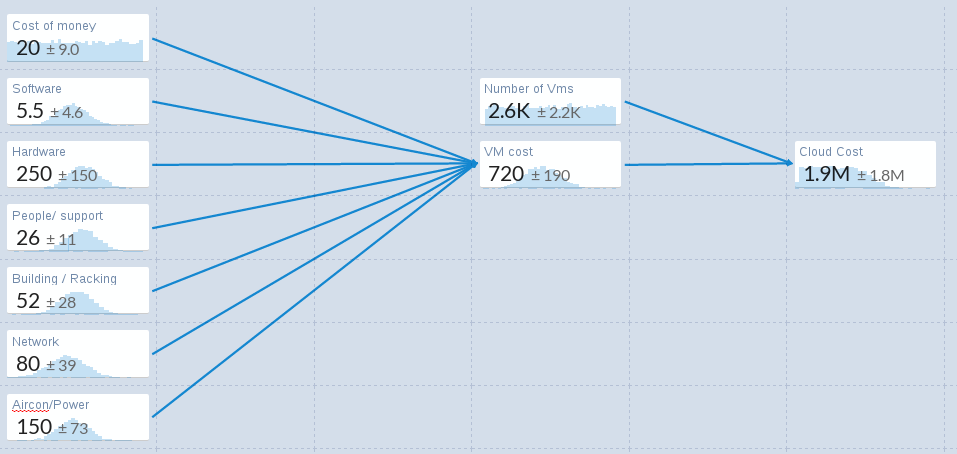
Now that we have a model, let's plug that into guesstimate. You can see in the picture below the result of the exercise. Note, DO NOT pay attention to the numbers, they are completely fantasist as I couldn’t get access to the latest IDC datacenter cost report.
Screenshot from 2016-02-06 20:51:09.png
Private Cloud TCO Guesstimate

What I ended up with is a really neat model where you can plug your own numbers and come up with a quick estimation of your private cloud TCO. It will take more work to generate a more accurate model but its good enough for basic estimation. In the mean time, you can find the source here. If you extend/change it, don’t forget to give me a shout. I am interested to see what other private cloud TCO model are out there.

Update 07/02/2016: +Carlo Daffara pointed me to his extremely detailed CAPEX / OPEX spreadsheet model. I'm going to see if I can translate it to guesstimate as a more advanced exercise.

Friday, January 31, 2014

On avoiding vendor lock-in by leveraging Openstack

One of the main drivers for user to adopt Openstack is to avoid vendor lock-in (see stats here ).

Architecture is rapidly becoming a commodity

Arguably, if you develop you own cloud solution you are locking yourself into yourself. Openstack in its current state require so much effort, customization, and maintenance that you end up building your own cage. Managing your maintenance and devs cost becomes critical in order to have a good ROI. Unless you plan to resell these services or expose them directly to your customers you won't benefit from the scaling strategy.

Often you might be better off  with a vendor lock-in as you "should" more easily control your costs and ROI. Or better, contract out your Openstack implementation from a third party and outsource the maintenance and development cost while retaining a certain degree of flexibility.

Different size , different strategy different risks

SMB customers can be very aggressive about getting into the cloud, and they do not have a legacy to deal with, whereas the enterprises tend to be very risk-averse. They have to protect what they have, and they cannot be as aggressive.

As a result we are seeing a number of mature enterprises looking toward a multicloud strategy. Whether that is through multiple platforms or whether it's deploying on an open cloud platform, the outcome that they are trying to achieve is the same. Enterprises are increasingly transitioning from general-purpose tools to point solutions as their IT environments become bigger and more complex.


Sunday, March 29, 2009

Amdahl's law and automation

The theory (and a little bit of practice)

Automation in datacenter and now utility computing is heavily used to drive down TCO cost. However it is rather hard to find out what to automate in order to get the maximum benefit out of it. Some automation that seems obvious often has a low return on investment.

Hopefully, we can use ( or abuse) amdahl's law here. It is used to find the maximum expected improvement to an overall system when only part of the system is improved. Interpreted simply, Amdahl's Law says focus on improving the things that make the biggest difference overall.


Pic: Amdahl's law


If we adapt this law for TCO reduction 1 is the cost of running the system (datacenter, service etc.. ) for a discreet amount of time. The new cost is will be the length of cost the unimproved fraction takes, (which is 1 - P), plus the cost the improved fraction takes. The cost for the improved part of the system is the cost of the automated part's former cost divided by the automation cost factor, making cost of the improved part P/S. The final cost is computed by dividing the old running time by the new running time, which is what the above formula does.

Applied to datcenters, cloud or IT operation, this logic suggests that organizations should start with automation that makes the biggest impact, particularly IT staff productivity.

The reality

The reality


However, if we look at the reality the OPEX cost for a server and a datecenter is represent a very small part of the overall cost. According to google paper it varies between 7% and 9 % of the overall cost. Which means that if we still follow Amdahl law automation can provide only a very limited impact on the overall cost while maximising server utilisation guaranty a better return on investment ( not to mention being smart with hardware acquisition).


But there is no small economy.