Showing posts with label business. Show all posts

Tuesday, June 30, 2020

Data is the new oil fueling Machine learning adoption but Businesses are discovering #AI is no silver bullet

Data is the new oil. However, unlike oil, as data scarcity is becoming less of a problem, processing costs are skyrocketing. The business world is waking up to the fact that while the cost of computing keeps getting cheaper all the time. The cost of training machine learning models is outpacing the compute cost drop.

Moreover,  business are finding challenging to adopt #ai, and the economist report numbers are showing how often #machinelearning projects in the real business world fail :
  • Seven out of ten said their #ai projects had generated little impact so far.
  • Two-fifths of those with “significant investments” in ai had yet to report any benefits at all.
Companies are finding that #machinelearning is not the promised silver bullet. The non-tech company are discovering what tech companies had to learn the hard way: that they are no Google, Facebook, ...

To successfully deploy an AI/ML/DL project you need: a vast amount of data, skilled employee, solid engineering practice, access to infrastructure and last but not least, a clear understanding of the business problem.

I have a false hope that corporation will abandon the silver bullet thinking, but I would settle for avoiding another #ai winter cycle.


Thursday, September 20, 2018

[Links of the Day] 20/09/2018 : Arxiv paper viewer, Artificial intelligent atomic force microscope, What they don't teach you running a business by yourself

  • Arxiv Vanity : If you are like me and read a lot of papers from Arxiv. This website will save you a ton of time. It allows you to render academic papers from Arxiv so you don't have to download or decipher the pdf. It makes life so much easier if you are on mobile and can't wait to read the latest paper on kitten deep learning recognition.
  • Artificial Intelligent Atomic Force Microscope Enabled by Machine Learning : the authors demonstrate how you can use artificial intelligence with an atomic force microscope for pattern recognition and feature identification.
  • Things they don’t teach you running a business by yourself : great short post on the different aspect of running a small business by yourself. If you want to start your own business, I would also advise reading "Start Small, Stay Small" - by Rob Walling and Mike Taber. It was an eye-opener. You don't have to go big with your business. Instead, you can run ten simultaneous businesses, diligently managing and tracking his time to run each one as efficiently as possible. It doesn't matter if one falters. This approach allows you to create a comfortable cushion and increase the chance of a higher payoff.

by dahlig

Wednesday, January 11, 2017

Ancillary business opportunities from the emergence of autonomous ride share car services

The list of self-driving vehicles and companies starting to offer services of these vehicles is ever growing. I recently started to be interested in the ancillary challenges brought by the deployment of a fleet of autonomous vehicle and the business opportunity that emerge.

There is two interesting business area with a certain potential: cleaning services and real estate. 

Support service ecosystem:

Supports services are the main area of expansion created by companies like Uber, Google making a foray in the autonomous ride share business model. They will more likely outsource these operation to third parties as it these business has a low-profit margin and tends to be hard to automate (as in requiring manual labour). 
I have three daughters under 5 and, let's face it, my car is a mess. It takes less than 2 rides to transform a clean spotless car interior in the equivalent of the Omaha beach d-day aftermath. And this is the same for taxi / uber drivers, the current best practice recommendation is to have cleaning implements and a throw-up bag at all time in the car in order to maintain high standard and rating. Not to mention the cleaning fee if things go really bad. 


Now if you have an autonomous car, you will need to have it clean often as they will be providing ride 24/7. 
Repair and maintenance requirements are obviously another areas that will need to be developed. By example, In Uber current model, the cleaning, repairing and refuelling is the responsibility of the owner of the car. However, when shifting to the autonomous ride, Uber will start to need to, either provide this service internally or outsource it. 
Refuelling and recharging might be less of a problem as there is a clearer way of automating the process. 


Real estate issue:

Another side effect is that for cleaning, recharging and repairing operations require real estate. You cannot deliver these service in the middle of the street. And this is another problem that corporations will have to solve. To some extent Google and Uber are trying to go around this issue by deploying their solution first in confined areas like college campuses, military bases or corporate office parks. As the owner of these private space will be able to provide space for free in order to benefit from the service. However, as they expand outside, this will become more problematic. Moreover, they might want to have buffer zone where the fleet of vehicles is at rest in off-peak periods.
Being able to deliver efficiently the logistic for support service while maximising resource efficiency will literally make or break the business model of autonomous rideshare. One possibility would be for these companies to contract, uber style, individual to offer their driveway and cleaning/refuelling services. Companies will be able to use the cleanliness rating made by the customer to evaluate the service quality of the individuals. This would partially solve the real estate issue until town planner starts to accommodate this new mode of transport. It will also allow to grow cheaply a widely distributed service point location. Enabling just in time servicing, hence maximising car usage efficiency. 


To some extend the new business model deployed by the like of Uber couple with the commoditization of service create new business opportunity for ancillary support services. Unsurprisingly, these services can copy or adapt the same business model to scale while keeping cost down. However, it might be a little bit too early for these to blossom as we haven’t reached peak Uber fade and fleet of self-driving cars are a couple of years away. I would probably keep an eye instead on the less glamorous but potentially more lucrative self-driving trucks business instead.

Monday, March 28, 2016

[Links of the day] 28/03/2016: Hierarchy of engagement, Latency measurement, TAO consistency at Facebook

  • The Hierarchy of Engagement : Another excellent Greylock partners's slides deck on how to leverage the Hierarchy of Engagement to fuel the growth of your company.The proposed hierarchy model has three levels: 1) Growing engaged users, 2) Retaining users, and 3) Self-perpetuating.
  • Measuring and Understanding Consistency at Facebook : paper summary of Facebook highly consistent DB : TAO. Interesting thing is that they have a hierarchical consistency model with synchronous cache consistency and asynchronous cache, DB/storage invalidation model.
  • How NOT to Measure Latency : in-depth overview of Latency and Response Time Characterization, including proven methodologies for measuring, reporting, and investigating latencies, and overview of some common pitfalls encountered (far too often) in the field

Tuesday, February 16, 2016

Is Amazon using Lumberyard to replicate its Video business model in Gaming?

Amazon recently launched its own gaming engine : Lumberyard. This should not seems as a surprise with the stream of high level investments they have been doing in the field over the past couple of years: Twitch.Tv or licensing Crytech engine (which form the basis of lumberyard) to name a few. Moreover, I will not extend on Amazon underlying strategic play as Simon Wardley already did brilliant job explaining it here and there.

A lot of discussions analyzing Amazon move have been centered around the long term strategic play in the AR/VR field. However, in the short term, Amazon might be aiming to accelerate the value chain shrinkage while potentially moving away from the traditional gaming industry business model to a service based approach and ultimately a complementary business model.

Historically, Work-for-hire & Royalty advance practices generated significant upfront fixed cost in the video game development business model which resulted in making publishers as the de facto main financial operator. Publisher typically mitigated these financial risks via portfolio management which exacerbate the reliance on franchise game (86% of the market). 

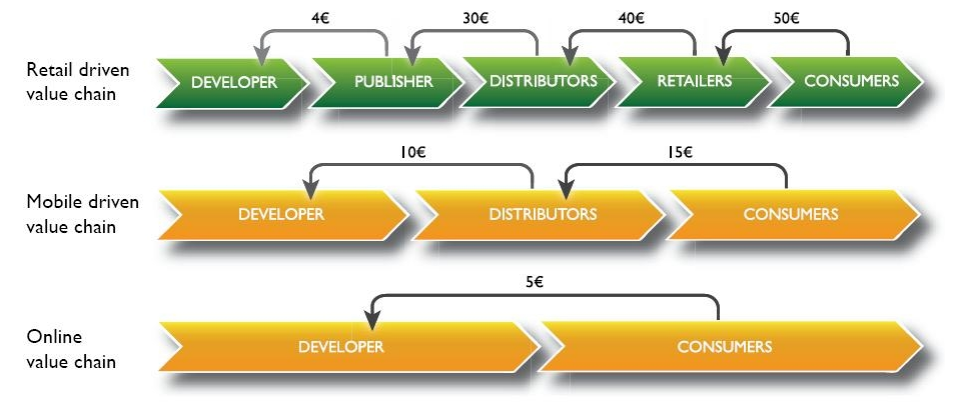
With the switch to digital distribution platform and the explosion of mobile gaming, the physical logistics needs drastically decreased while the barrier to entry vanished. This commoditization trend effectively shrinked the value chain significantly as show in the diagram below. 


Moreover technology evolution enabled an increased variety in revenue model : 
  1. Subscription : Subscribers pay periodically to get access to the game (ex: World of Warcraft)
  2. Utility : metering usage, i.e. a pay as you go approach. This model is widely used among MMOs in China. 
  3. Advertisement : sometime used in combination with other model in order to enhance revenue. Pure advertisement model are mainly found in mobile.
  4. Micro-transaction model : dominate Eastern markets 
  5. Licensed : historical revenue model
  6. Free to play : combination of other revenue models , ex Advertisement + micro transaction.
There is two other business model that are still nascent in the gaming industry: Service and Complementary. And this is where, I believe, Amazon is aiming all along with its gaming push.


If we look at the value chain above Amazon's plan seems extremely straightforward. By facilitating production systems via “free” access to lumberyard Amazon facilitate the emergence of gaming studio. This open platform with efficient underlying support system (AWS) and with great customer exposure (Twitch.tv) will drive the commoditization of content creator and by transitivity content itself. This approach literally cut the grass under the foot of traditional gaming corporation that relied on a high barrier to entry ( via game engine licensing, distribution network, backend, etc..).

By analyzing beyond the pure technological aspect we can quickly theorize that Amazon might be aiming at pivoting the gaming revenue model completely. Amazon could push for a Netflix like service model. However, there is a greater chance that it will follow the same approach it used for Amazon Video. Amazon could start offering Video Game access (downloading via app store steam style first, streaming later) free as a complementary to Amazon Prime customers. Prime serving as an incentive and creating opportunities for more lucrative cross-sell and up-sell opportunities. The Gaming service attracts customers to Amazon store, where they can purchase the content which is not available for free, as well as other products from Amazon. Moreover the overall business model effect would be further reinforced through the Twitched.tv broadcast platform. 

Obviously, to support and accelerate this model, Amazon will need to start producing its own games. It needs to offer an attractive gaming experience that cannot be easily replicated while co-opting the rest of the industry at the same time. 
One of the key element regarding the pace of change will be dependent of the commoditization of the hardware platform and co-optation of existing one. If Amazon is able to broker a deal with MSFT or Sony ( the later is more likely because they already run their services on AWS). They would be able to gain a foothold in the gamer market. However, by co-opting the “hardcore” PC market , TV causal (Fire TV) and mobile, Amazon should be able to squeeze out the competition. Even if the console put up a fight, they would be able to enshrine in concrete any market gain by enrolling top game studio and capturing gaming franchise.

Last but not least, the value of console hardware is dropping fast while console software value is increasing and already exceeding hardware. Similar relations are to be found for handheld devices with an even greater gap. Amazon, just has to wait for for the gap to reach a critical point and then wipe out the nascent video game streaming industry by leveraging its existing expertise from VDI (workspace). All of this would be a textbook replay of the Amazon Video strategy. 

The future of gaming is about to enter a new era. While the AR/VR future is exciting there is a gaming business model war looming that will hit way before these technologies reach maturity.

Friday, January 29, 2016

[Links of the day] 29/01/2016 : RabbitMQ internals, Business architecture, Unit of value

  • RabbitMQ Internals : High level architecture overview explain how RabbitMQ works internally. A must read for anybody out there using RabbitMQ. 
  • Business Architecture- Upwards, Downwards, Sideways, Back : bridging the gap between IT architecture and business architecture. How both are intertwined but fulfill different purpose. 
  • Unit of value : Greylock partner post on how to look at your product pricing, and the implication to your sales and scaling strategy.

Tuesday, November 24, 2015

Links of the day 24/11/2015 : Product prioritization using the Kano Model and Timers


Wednesday, September 09, 2015

No, "you weren't ahead of time", you just were riding the wrong diffusion curve

Launched ahead of their time” - a claim a lot of startups (and indeed more established companies) use to explain their product failure. In some rare cases, a product is truly ahead of it’s time, however, there is no market for it at all and no supporting component within the supply chain enabling it to be viable commercially and economically. But in most cases, these claims can be boiled down to a lack of traction from their offering. 

In this blog post, I will focus on the “prematurely interrupted” hockey stick growth curve that some companies experience and the misunderstanding surrounding same. It looks and feels like exponential growth, but the ride terminates far earlier than the potential market research predicted. Incomprehension, surprise and denial are often common when the sales flat-line occur because customer feedback was great. As a consequence, companies use the “ahead of their time” excuse to explain their failure. However, the truth is the market for the product they built simply dried up.
Often these companies misunderstood the true reality of the diffusion of innovations curve presented below. With successive groups of consumers adopting the new technology (shown in blue), its market share (yellow) will eventually reach saturation level. The interpretation is that the technology adoption implies same product consumption across a consumer group. 
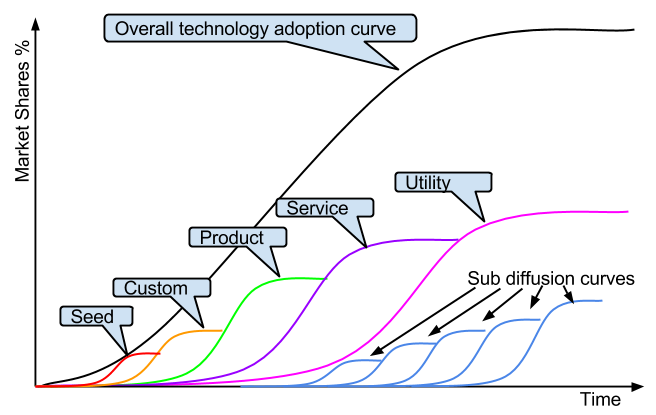
In this graph, each phase of the adoption is represented by a different customer group that requires a tailored product in order for them to adopt it. While the concept and technology to a certain extent is similar across each consumer group, the actual product may vary drastically in shape and form. As a result, the technology, product, and consumption model evolves with each phase at different pace. In the graphic below, I have overlayed the actual diffusion curve of each sub group on top of the diffusion of innovation curve, in order to make it clearer. Note that this concept is derived from Wardley’s mapping technique tying diffusion and evolution within a single map.

As you can see, each customer type represents an independent sub-market with its own characteristic and inertia. It can be extremely easy to become trapped within a sub customer ecosystem. Often companies validated their products within such subspace and show impressive stats along a number of dimensions, such as high engagement, viral coefficient, or long-term retention. However, what is important to understand is how big is the customer market you validate your product in as well as asking the question, does it belong to a bigger ecosystem? Without this information, a company can quickly end up trapped into a local maxima. As a result, companies get boxed into a line of creative design thinking making tiny incremental improvements but never looking beyond that one solution. They became addicted to positive reinforcement, created out of their customer feedback, thereby preventing them from looking beyond that one solution to an innovative solution along different creative lines of thinking. That's how a company ends up having hipchat vs slack. The only difference between the two is the packaging of technology and it allows one to thrive along a bigger diffusion curve, while the other one seems stuck.

As mentioned, the technology evolves over time and with each diffusion wave. Quite often from genesys, custom built, product, and finally utility. However, there are many chasms to cross as there are a multitude of competing versions created, evolved (and dying). To be able to cross from one stage to another requires not only to understand the technological requirements of the new consumption model for the diffusion curve, but also the economic imperative associated with it, as shown in the graphic below. The reality is that the market fabric is a fractal tissue, made of a multitude of diffusion curves. You have the actual technology evolution as shown in the graph below, for each of these curves you have the same similar sub-curve representing the various adoption rate. These sub-curves are then subdivided and overlapped with smaller ones created by each company's product/services competing within the space.


This overall complex fabric creates a difficult environment for determining the correct strategy to apply. Identifying the current state of the ecosystem, its direction and when to adapt is a daunting task with a multitude of variables to take into consideration (which I might try to take a stab at in a future post). For the lucky or for the visionary, that spot the trend early enough, they may then attempt to sell early, or pivot their strategy. Pivoting their strategy is a rather difficult operation to execute correctly or even at the right time. Too early or too late and you can lose momentum of the current diffusion wave while the next one might not have picked up yet. In this case, your capacity to wait it out depends ruthlessly on your burn rate. Many companies fail at that stage simply because of bad timing.

To conclude, often when a product, company or startup claims to have failed in their endeavours because they were “ahead of their time”, this is a misconception. In reality and unfortunately in the majority of cases, they simply did not understand the ecosystem they had evolved in and got stuck in a local maxima. For some, it turned into a kiss of death while others, into a curse of zombification.

Monday, January 19, 2015

Links of the day 19 - 01 - 2015

Today's links 19/01/2015: Data-structure books, #cloud and business agility, Leslie Lamport interview