Showing posts with label hypervisor. Show all posts

Wednesday, January 04, 2017

[Links of the Day] 04/01/2017 : ProxySQL, Smudge Golang lib, Hypervisor costs comparisons

  • ProxySQL : SQL proxy fir MySQL ( or any other fork like Percona and Mariadb) [Github]
  • Smudge : Go library providing group member discovery, status dissemination and failure detection using the SWIM epidemic protocol. This is really cool as provide a building block for an equivalent to consul but with a very low footprint ressource and network wise. 
  • Hypervisor costs : interesting comparison of hypervisor solution costs. The surprising number is that contrary to popular belief VMware is not the most expansive but Hyperv is on a apple to apple comparison. However I am not sure that this hold true when you are talking for a complete solution.


Monday, January 02, 2017

[Links of the day] 02/01/2017 : Cloud Cron, KSM hypervisor, Technology landscape radar

  • Cloud Cron : cool tool for executing cron job on cloud
  • KSM : while the name might be confusing ( KSM also stand for kernel shared memory). KSM is a neat small hypervisor and support a lot of hardware feature.
  • Technology Radar : ToughtWorks maintained technology landscape. Really useful to spot what up and coming tech are been baked by different startups. Also at what stage are the different technologies


Monday, August 24, 2015

Links of the day 24/08/2015 : #Docker vs #kvm vs #Osv performance, #Linux NVM programming tutorial and Datacenter SLA ontology


Monday, November 17, 2014

Virtual Cores tech and partitioning hypervisor

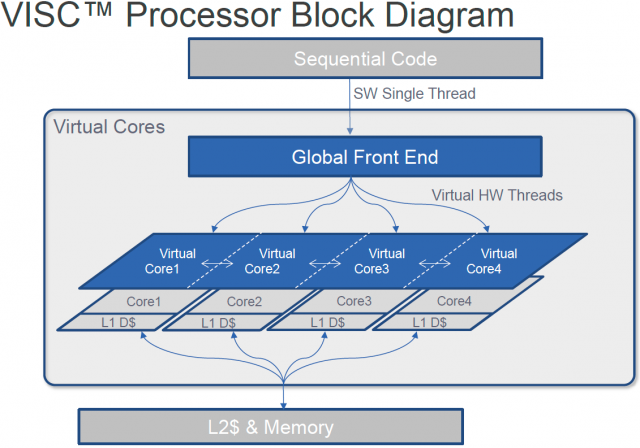
A couple of weeks ago Soft Machines came out of stealth mode and introduced the Variable Instruction Set Computing (VISC). VISC attempts to avoid the difficulties of scaling multiple threads in hardware by providing a framework in which workloads that appear sequential to the operating system are then scheduled across a set of virtual cores in hardware.

VISC-3-640x448.png
What is interesting here is that most often virtualization has been leverage to deliver fine grained (over)subscription from your system. The disadvantage is that with such technology you have often a penalty to pay. It is on average between 5 to 10% but it can be less or worse depending of the workload and over-subscription scenario. One alternative for separating critical applications while guaranteeing performance and isolation exist: partitioning hypervisor such as jailhouse.

Jailhouse can create asymmetric multiprocessing (AMP) setups on Linux-based systems. What it effectively does is partition the physical hardware into cells and guarantee the isolation between them. Effectively it use some cores to run a Linux based hypervisor to manage and partition the rest of the hardware. Each OS or virtual machine effectively run only on its dedicated core and hardware. The typical workloads we expect to see in non-Linux cells are applications with highly demanding real-time, safety or security requirements. However the trade-off is that you are under subscribing your system in order to guarantee high performance and isolation.

Now enter VISC, with such technology you could in theory eliminate the under subscription problem while retaining the performance and isolation characteristics of partitioning hypervisor. What would be interesting to see if this cpu architecture will be able to leverage this type of hypervisor technology to gain momentum within the cloud. Workload such as network virtualization function or virtual network systems would greatly benefit from such approach as the overhead of classic virtualization is a significant limiting factor.

Wednesday, November 05, 2014

Links of the day 05 - 11 -2014

Today's links 05/11/2014: #Docker and #LXD, scalability rule, Google #containers engine

  • LXD : Shuttleworth announce LXD, a secure container technology design to address the isolation and security concern of exiting solution.
  • Scalable commutativity rule : Whenever interface operations commute, they can be implemented in a way that scales
  • Container engine: interesting that Google offer multiple container per VM management (1:M) while all its concurrent only offer a 1:1 mapping. 

Tuesday, July 29, 2014

Links of the day 29 - 07 -2014

Today : Deep learning,  cloud market state of play, Cloud Infrastructure Mgmt tool, and Container vs Hypervisor performance comparison.