Technical debt is a term commonly used in the IT sector. This term, first introduced by Ward Cunningham, describe the deferred necessary work during the planning or execution of a software project. However, while the term debt comes from the financial vocabulary, quite often the analogy stops there. I find this rather disconcerting as we can borrow more than the terminology, we can borrow the mechanism associated with the term in order to prevent, address, classify such liability. Some started already to push the
analogy closer to the economic concepts. Lets first have a look at the two main type of technical debt.
External vs. Internal Debt :
We need to understand that developers group maintain two type of debt, external and internal. The external debt represent the total amount of deferred work that was contracted or required by a third party. The creditor can be a customer, another group within the company, feature for the product manager, etc..
On he other side, we have the internal debt, which is only visible within the group and only impact the work executed internally. Like the submerged part of an iceberg, the internal debt is invisible to the outside world, tend accumulate faster,and is sometime the reason for the creation of external debt. Moreover, the internal debt often need to be resolved in order to chip away at the external one. This dependency increase significantly the cost of paying the external one.
In order to maintain the analogy, we could describe internal debt as credit card debt, payday loan, etc.. Easy to acquire and accumulate and snowball easily if we don't pay attention. While, on the other side, the external debt is more like contracting a mortgage for a house, any failure to repay it can lead you to deep trouble. Internal debt tend to have a high interest rate as the more you wait the higher the chance you pile up more debt that you need to repay while the external one tend to have a lower one.
To follow the analogy we can classify the debt as follow :
|
Internal
|
External
|
Frequency of acquisition
|
high
|
Low
|
Visibility
|
low
|
high
|
Interest Rate
|
high
|
low
|
Risk
|
low - medium
|
High
|
How do team accumulate debt :
It is not rare to see team, project, company being trapped in the IT equivalent borrow-and-spend cycle. Lets have a look at the technical debt acquisition spiral.
Project inception:
The Technical Debt (TD) slippery slope can start right at the project conception phase. Often, part of the requirements, statement of work, and/or analysis are missing. This situation can quickly create an initial credit buildup since trying to fulfill correctly the work at that stage is often unfeasible due to lack of real understanding of the requirements. For many people TD become the only choice. TD generation immediately puts the project in a bad position as you are accumulating debt at a time when you probably do not have enough "velocity" to make even a single payment in an effort to reduce the debt balance. However, often you do not have a choice unless you are part of a big enough organisation that can weather the initial cost.
Daily project routine :
The daily development effort soon come into play to help you cover Internal TD cost. However, often this internal TD is accruing interest and putting you deeper in debt. Moreover, the high interest rate of the internal TD make it even harder to catch up on the debt you already contracted at the inception stage of the project.
Real requirement settle in :
Like most project, at some point the actual requirements comes in forcing you to re-evaluate the technological choices as well as established scheduled. Sometimes, you need to acquire a certain type of technology, skill set or even workforce to cope with this mutation. With every acquisition comes a certain amount of inertia to fulfill it further increasing the debt burden.
Customer comes in :
Here, external debt start to form as milestone and deadline have to be met. Quite often to meet them teams cut corners and the hidden internal debt accumulate in order to avoid default on the external one. At this stage, the project risk spiraling out of control unless we establish clear way of dealing with the increasing cost of debt.
Preventing technical debt accumulation :
How do we resolve the debt crisis that every group face at some point ? Like any financial issue, you need to have a plan.
Preemption via process management :
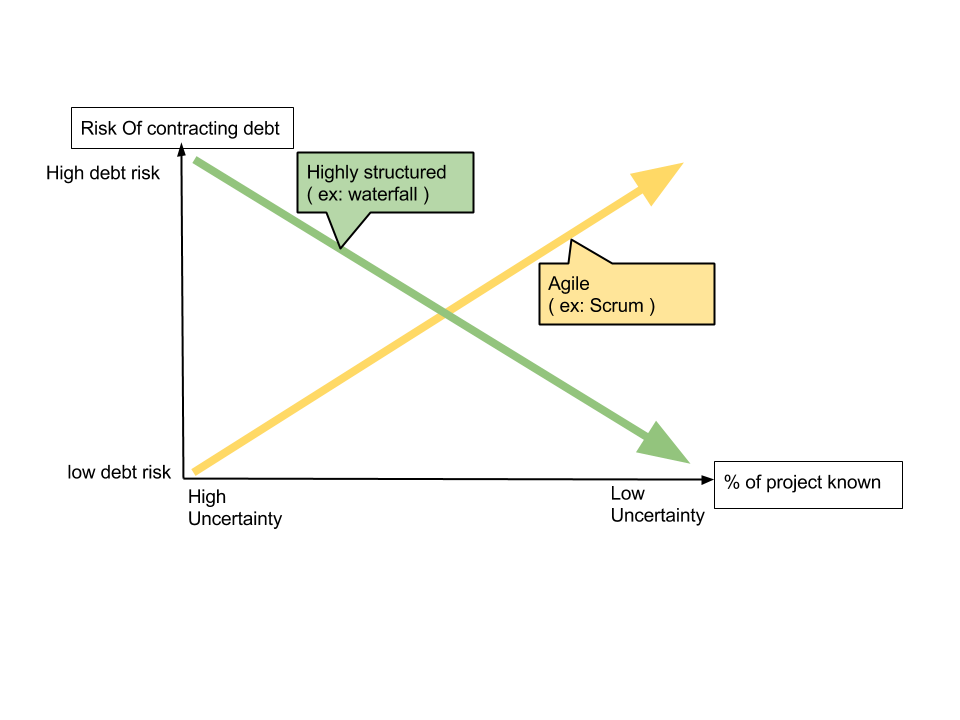
One of the most common way to prevent debt buildup is to use a process management method. Agile approach like Kaban or Scrum are in vogue for the moment. They tried to enable just in time delivery by minimizing the development cycle in order to allow as much agility as possible. Effectively, it limit the potential amount of debt that can be accumulated before taking action and enables greater visibility.
However, do not dismiss the other approach such as waterfall, TOGAF, ITIL, 6sigma, etc... Each alternative have their own merits, default and should be used depending of the circumstance. Agile method are best used when the project inception phase generated a lot of debt ( in term of unknown requirements by example) and create the need for a on the fly adaptation model to deal with changing requirements.
More industrialized development project with defined, well understood and highly repeatable efforts are more effectively managed by a highly structured method. Agile approach would create too much waste and potential dispersion which result in technical debt generation.
Remember, one size doesn't fit all and moreover you need to adapt your process as the project mature ( or change ). By example, with the structured approach in a rapidly changing environment you end up rapidly overrunning your allocated resources due to change control associated with structured methods i.e. you're applying a method designed to reduce deviation to an activity that is constantly deviating.
Snow balling:
This classic debt reduction strategy simply target the technical debt that can be payed off the fastest and you work you way up the debt pile. This requires to have a clear understanding and provisioning of resource to deal with it. However, if you end up strapped in resource this is not always possible. One of the great thing with this approach is it create the perception of momentum which help reinforce the team commitment in dealing with this predicament.
Too Big to Fail :
This options might be riskier, but if you are desperate, you might want to try it and hope for a not too painful bailout. Simply put, you are trying to externalize the risk by following the old adage : “If you owe a bank thousands, you have a problem; owe a bank millions, the bank has a problem”. The objective is to rely on investment by piling up external debt in order to subsidize your budget. As a result, the overall exposure of the company force it to invest more into it in order to avoid significant repercussion at a larger scale.
On the downside, you have to be careful to not hit the debt wall. This can happen when the project external debt outweigh the benefit of pumping more resource into it. The consequences are that project manager and all the members of the team may lose significant reputation and also impact negatively their career or position within the company.
When it's already too late:
Well when you are in too deep with technical debt there is various options. But you need a plan to mitigate the personal and corporate impact.
First you need to acknowledge the issue. Then you might consider notifying the creditor(s), the product manager by example for internal debt or the customer for the external one. however, i would suggest considering the various options at your disposition:
- Negotiating a technical debt adjustment with your creditor by stretching some for of debt over a longer period of time. However this can only be applied to external debt due to its nature.
- Alternatively you could try to consolidate your internal debt by exposing it to the external parties. Effectively refinancing your technical debt by securing a lower interest rate on the entire debt load. Typically this would take the form of dedicating a whole sprint to address the internal debt by demonstrating its value to the customer.
- Finally you could seek debt relief with a partial or total forgiveness. This could take the form of re-scoping the requirements, realigning the statement of work etc..
Beyond hope :
Most of the time this part is completely ignored in technical debt talk or paper. It is kind of a taboo subject but is still essential to be aware of. Sometimes, you might want to consider defaulting on your debt altogether. By claiming insolvency, you are declaring that you are unable to meet the technical debt fulfillment obligations. Insolvency occurs when the amount of work needed to clear the technical debt is higher than the net worth of the project itself. Quite often, you might want to keep an eye on the debt accumulation rate and stop the project or deliver it /pass it on before it reach that stage.